
Jan 1, 2022

Like It Or Not, It's Time For This Stroke Survivor's Top 5 New Year Resolutions!


This year has been tough, more for some, less for others like me who occasionally don't mind being shut in the cocoon to write. But, alas comes the time for New Year's Resolutions. I love to write resolutions because it gives me words and actions to be accountable for. So here goes!


1. I will never stop being a vegan. Veganism gave me more energy where I only take limited naps a month. I restrict my diet to only vegan things and the one food that I loved--corned beef--I don't miss at all. 

2. I promise to do my exercises regularly. Three times a week was told to me when I started out. But now, everyday is advised by the physical therapist. Sometimes, I'm tired and just don't feel like exercising, but I'll take a power (15 minutes) nap and try again.


3. I want to see Brain Exchange flourish continuously because I have devoted the rest of my life to survivors of stroke and other traumatic brain injuries (TBI). Sara and I started Brain Exchange that sets up a writing partner 1:1, like the old pen pal program, to everyone who joins the initiative that is EXCLUSIVELY for stroke and other TBIers and meetings where everyone shares the struggles and joy, plus a Facebook group called Brain Exchange. If you know anyone who fits the bill, please have them look me up on Facebook.


4. The one thing every therapist said--physical, occupational, speech--in the 12+ year I've had my stroke is drink a lot of water to keep you hydrated. I like tea and coffee, and there's no difference with water for hydration. But herbal teas and decaffeinated coffee are fine because the caffeine will make you more anxious if you have more than two cups of the caffeine varieties. But I like fruit-infused water. Throw some lemon in your thermos of water and it's being hydrated with water and Vitamin C all at once!  
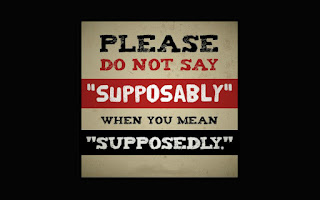

5. I will refrain from correcting anybody who says "supposably" rather than "supposedly." As Dictionary.com says: "
While supposably is a real (if rare) word, most people will opt for synonyms such as possibly or conceivably. Because many mistakenly believe others using supposably is a mistake, a lot of people avoid supposably so as not to invoke the wrath of people who are supposedly grammar snobs." 

I learned something new. I am a snob.



6. I'm almost a third done my memoir and I want to finish it by 2023. I have everybody in there -- my family, my childhood, my adult years, my sucky marriage, my suckier ex-partner. But writing comes easy to me, and I'm resolute to publish it. Stay tuned, readers!


Nov 25, 2021

Fall Upon Fall: The Wheelchair Was the Logical Next Step

I received the news as what I perceived to be a bevy of people sitting in my living room four years ago. It was me against them, so many of them, I thought. And it actually wasn't a bevy.

"I regret to tell you that you're going to be in a wheelchair, now that you had six falls in the space of four years, until you build up your leg muscles," said the social worker, who was surrounded by a physical therapist, an occupational therapist, my caregiver, the nursing coordinator, and a student nurse who was looking sorrowfully at me. 

I thought the social worker was smug and must have said those words to other stroke survivors, and actually eleven falls in three years, to be precise, and I scoffed at the idea. Me, in a wheelchair. I was using the cane at the time, but with every fall, I regressed in my ability to walk, and my narrative followed.

"I just want to be where I was before the fall," I pleaded every time. But every time, my ability to walk was further back than it was the previous time. 

"It will be safer," the social worker continued. Safer, a favorite word of every PT. Nobody asked me if I'd rather be safer. Maybe I don't want it to be safer, I thought, obstinate, stubborn to a fault. Maybe I'll take my chances, see where things end up. 

Fast forward five years. I'm still in the chair, actually a transport chair, which a person behind me has to push once my legs get tired after 10 minutes of propelling myself. 


But when I took yet another ambulance to the Emergency Room and needed thirty stitches to close the tear on my good leg right down to the joint after hitting my leg on the dresser which had sharp brackets, leaving behind a bloody mess in the bedroom, I knew, at that moment five seconds after the fall, I would have no more. No more of any of it.

While I was in the hospital for three days, three things happened. First, my son and my aide rearranged the bedroom where my leg could hit nothing. The dresser was moved to the opposite wall. 

Second, I got a floor-to-ceiling which my younger son installed that helps me with both exercise and transfers. 

And third, Sara and I founded Brain Exchange, exclusively for stroke and other TBI survivors to write ongoing emails in a 1:1 partnership which keeps me busy throughout the day and is helping me forget about the nursing home hellhole I was situated in for five weeks.

The renowned Daniel Gu who had a stroke, the founder of Strokefocus, developed the sign-in form and logistical meetings among Daniel, Sara, and me, and ever-pleasant Anne Tillinghast, who didn't have a stroke, the musical director of The Backstrokes (a band of stroke and other TBI survivors of which I am a member playing keyboard, the others mostly string and percussion, singing and playing every week) assists the effort.

So all of this is to say, I'm better now, still having physical therapy at home, and thankful for the Thanksgiving that I will attend later today with my sons and son's girlfriend.

I haven't fallen for four months. Will I fall again? How the hell should I know! After every fall, I said it would be the last, and you see how well that turned out.

Nov 7, 2021

Can You Rid Yourself of Bad Habits and Thoughts Like Smoking and Strong Dislike With BWRT? It Worked So Far for Bobbie!

Hypnotist and Bobbie

As a stroke survivor, I once considered hypnotism as a way to walk fast again. The doctor said hypnotism doesn't cure weak, atrophic body parts. But then there's Bobbie.  

First, a little background. Bobbie is my caregiver, a word I hate except when Bobbie says it. She is a "real" caregiver, state-licensed, not somebody who goes into caregiving as a hobby or, worse yet, a past-time to get money for alcohol or drugs. I  had a few caregivers like that. (https://stroketales.blogspot.com/2020/12/being-comfortable-in-mind-and-spirit.html)

Anyway, Bobbie goes through, at least, a half of a pack of cigarettes daily. She smokes in the car with the window rolled all the way down and it doesn't bother me except for the fact that she has COPD, high blood pressure, and one heart attack around five years ago, and I don't want to lose her. Bottom line: Cigarettes aren't good for anybody, especially with her medical history. 

Since the day she arrived, she always said she wished she could stop smoking cigarettes, but she never did until now. She hired a hypnotist at $100 per session who uses Brain Working Recursive Therapy, or BWRT, as a method. She had her first session last Wednesday, and hasn't had a cigarette since. Two more sessions to go to reinforce.

Oh, she still has urges. She just squeezes her thumb in the fold when she feels that longing, most likely learned when she was "under." She takes care of her 80-year-old mom who lives 110 miles away on the weekends. That long drive is tough on Bobbie because automatically, she'd reach for that cigarette. But since Wednesday, she hasn't touched one. 

Bobbie will continue with BWRT because that method also aligns with getting rid of bad thoughts. Her sister and brother tried to pry guardianship of mom away from Bobbie in a couple of court cases, citing phony physical, emotional, and financial abuse. Her sister and brother lost every time. I know her mom and met her on many occasions. A more loving duo between Bobbie and her mother does not exist!

But Bobbie wants to be done with the hate and repulsion she has for her sister and brother. BWRT to the rescue! Her hypnotist says BWRT will work for that loathing, too.

As Mark Twain said, "The secret of getting ahead is getting started." And you got started, Bobbie! Woo-hoo! 

And if you have bad habits and/or thoughts, and who doesn't, find a hypnotist and ask about BWRT first before you spend your money. You'll eventually find one. It's worth the wait.  

Oct 23, 2021

Pen Pals: The Destined Duo of Me and Sara


The trend of Pen Pals started during 
the 1930s. But the second World War came in 1939, and many of those Pen Pals disappeared--moved or died, never to be active again. Once it ended in 1945, life settled down at last.

This story caught my eye about Pen Pals. Carole Lechan of Massachusetts and Jane Anderson of New Zealand have been pen pals since they were nine years old. Last week, after 56 years of writing, they finally met.

 RACHEL MARTIN, HOST, as printed in NPR (National Public Radio):

Back in 1959, a little girl from Queens, N.Y, sent an airmail letter to another little girl in Sefton, New Zealand. The New Zealander wrote back. And the two began a correspondence that has lasted for 56 years. The two lifelong pen pals never met until last week. When Carole Lechan and Jane Anderson spotted each other at Logan Airport in Boston, they each smiled and locked arms in a huge embrace. Five decades after they first began writing, Anderson had finally come to find Lechan, who now lives in Massachusetts.

The old friends told The Boston Globe that they wrote each other five or six times a year, sending letters written in longhand that could take weeks to reach their destination. Carole Lechan said, quote, "when someone writes you a letter, you are bound by responsibility and courtesy to respond. So we just kept writing."

The two had updated their correspondence to email in recent years. But as strange as it may seem, they had never even spoken on the phone. I was just really surprised she would make this investment to come see me, Lechan says. But we're not getting any younger. And this is the time to do it.

I read those words and they seemed unlikely to happen to me. One in 100 million, I thought. But I have a Pen Pal now, too.

I never met her. We never talked on the phone. But in late Spring of this year, she inquired where she can find a copy of my book, The Tales of a Stroke Patient. Or she read my blog, The Tales of a Stroke Patient and More. I can't remember. It's as if she has always been here. Her name is Sara.

And so it began. I worry about Sara. She worries about me. I get her misery; she gets mine. We email or text, sometimes both, almost every day. She knows my children's names; I know hers. I know her husband's name; and I am happily divorced. I know her favorite things; she knows mine. But at the crux of it, why are we so connected? We are both stroke survivors. 

There was something about Sara that charmed me. So I sent her my book after she gave me her address. She has favorable qualities--smart, friendly, attentive. I convinced her to join my Zoom support group so we could look at each other.

She was thinking of writing a book and her stroke misadventures. When I wrote my book, in the dusty back room of my ex-partner's house, he was always upstairs, I later knew, partly to escape me. I believe I repulsed him because the roles were reversed, much to his disdain, and I couldn't do the things I once did like go market shopping, help with the gardening, prepare meals. The only positive thing was I had no problem finishing the book which took two years. There wasn't a week that passed when I didn't say to myself, I wish I had an editor to help me with wording choice, chapter order options, proofreading.

So it was natural that I came to assume editorship at no charge of Sara's book. In Google docs which are shared between the two of us, I read all of her chapters to date--she has six--and I plan to stay with her not only until the book is published but for the long haul.  

I feel a kinship and I'm inspired to starting a Pen Pal program among brain injury survivors--someone who understands, someone who gets you. Me and Sara--I think that's reason enough to get the ball rolling.

Oct 3, 2021

No Use in Hiding It Anymore. I Have Aphasia.


Aphasia is one of those conditions you can't hide for long. You can say, "I'm having a senior moment," but when you say it all the time and you're a stroke survivor, you have to come to terms that it may likely be  aphasia.

Here's a quick rundown of the 2 million people, in the US alone, who have lost all, or part, of the ability to use words to communicate:

  • Aphasia is an impairment of language that can affect both the production and comprehension of speech and impair a person’s ability to read and/or write.
  • Aphasia is always caused by an injury to the brain.
  • Stroke is the most common cause of brain injury that leads to aphasia.
  • Other brain injuries from head trauma, infections, or tumors can also cause aphasia.
  • Aphasia can be mild and only affect a single aspect of language OR it can be so severe that is incredibly difficult to communicate with the patient.
  • Most commonly, multiple aspects of communication are impaired.
  • Some people can recover from aphasia, but if they have it longer than 2 or 3 months it is unlikely they will recover.

Aphasia is defined as an impairment language caused by an injury to the brain, usually due to stroke, but it could happen from any type of brain injury.

Before April, 2009, I used to be a public speaker, communicating to crowds of people in an extemporaneous fashion, the words flowing with no effort, ad-libbing in an  impromptu fashion. Now, I know my limits and I'm scared.

Are there differences in types of aphasia? There surely are, and thanks to the UK Stroke Association for this quick guide:

Broca's aphasia (non-fluent aphasia)

Broca’s aphasia or expressive aphasia is when people find it very difficult to find and say the right words, although they probably know exactly what they want to say.

People with Broca's aphasia may only be able to say single words or very short sentences, although it’s usually possible for other people to understand what they mean. This can be very frustrating.

The features of Broca's aphasia are:

  • Severely reduced speech, often limited to short utterances of less than four words.
  • Limited vocabulary.
  • Clumsy formation of sounds.
  • Difficulty writing (but the ability to read and understand speech). 

Wernicke's aphasia (fluent aphasia)

Wernicke’s aphasia or receptive aphasia is when someone is able to speak well and use long sentences, but what they say may not make sense. They may not know that what they're saying is wrong, so may get frustrated when people don’t understand them.

The features of Wernicke's aphasia are:

  • Impaired reading and writing.
  • An inability to grasp the meaning of spoken words (producing connected speech is not affected).
  • An inability to produce sentences that hang together.
  • The intrusion of irrelevant words in severe cases. 

Anomic aphasia

The features of anomic aphasia are:

  • An inability to supply the words for the very things the person wants to talk about, particularly the significant nouns and verbs.
  • Speech that's full of vague expressions of frustration.
  • A difficulty finding words in writing as well as in speech.  

Primary progressive aphasia (PPA)

Primary progressive aphasia (PPA) is a condition where language capabilities become slowly and progressively worse, leading to a gradual loss of the ability to:

  • Read.
  • Write.
  • Speak.
  • Understand what other people are saying.

Deterioration can happen slowly, over a period of years. Other mental functions such as memory, reasoning, insight and judgement are not usually affected.

It's important to get an accurate diagnosis for PPA. This is to rule out other degenerative brain disorders like Alzheimer's disease where language and memory and reason are affected.

The operative word here is "may." I have mostly Broca's aphasia, but I have no trouble with written expression. In fact, words come about easily through writing rather than speaking. 

I was a Communication prof so being able to say words clearly was important in my playbook. Am I disgruntled at my speaking ability? You bet. Would I ever accept the stroke? No way. But if I don't fall anymore, that would be good enough for me.